


Start with the question, not the keyword density
AEO begins by identifying a question that has a stable underlying intent. The wording may vary, but the user is trying to make one decision or understand one concept. The page should state the answer early and then earn trust with the reasoning underneath it.
Repeating the target phrase does not make the answer better. Clear nouns, entities, numbers, limitations and examples are more useful because they make the passage self-contained.
A practical answer-first structure
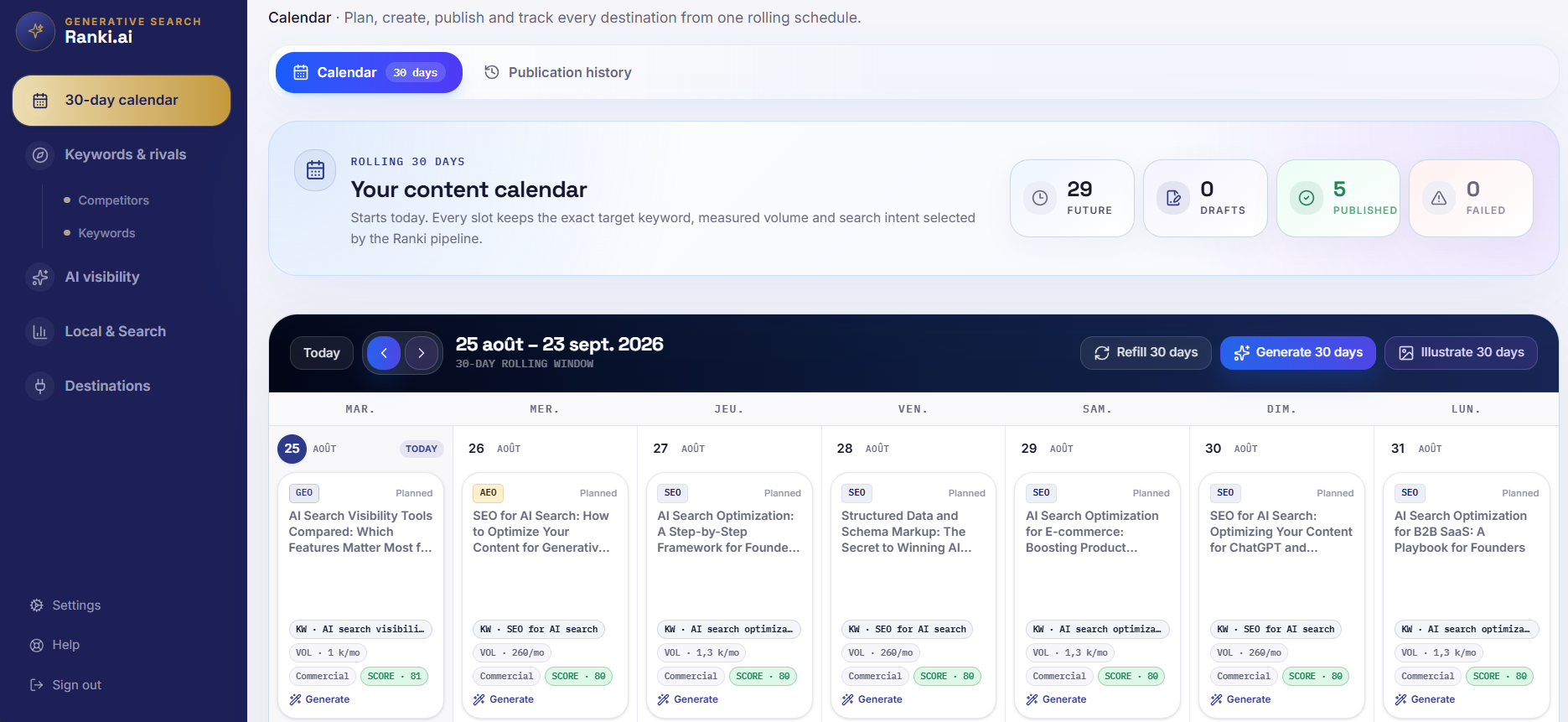
The most reusable answer pages are easy to scan for both people and retrieval systems. Ranki.ai uses format-specific planning so AEO slots are not treated like generic long-form SEO articles.
- Descriptive H1 that states the question or decision clearly.
- A direct answer block in the first screenful of useful content.
- H2 sections for criteria, steps, alternatives, limitations and examples.
- Lists, tables and definitions only where they improve comprehension.
- FAQ questions that add new information rather than repeat the same answer.
Use evidence where the answer can become expensive
The more consequential the decision, the more important it is to show where a factual claim comes from. Product pages should use first-party facts. Statistics should have a source. Comparisons should explain criteria. If a claim cannot be verified, removing it is better than padding the answer with plausible language.
Frequently asked questions
What is the difference between AEO and featured snippet optimization?
Featured snippet optimization targets a specific Google result format. AEO is broader: it structures a page so multiple answer systems can identify and reuse a concise answer.
Does every article need an FAQ section?
No. Add FAQs only when they answer distinct follow-up questions. Repeating the same answer in several formats creates noise rather than additional relevance.
Can AEO pages also rank in normal Google results?
Yes. AEO uses normal indexable web pages, so the same page can earn organic visibility while also being easy for answer systems to parse.
Ranki.ai · GEO + SEO + AEO on autopilot
Turn the strategy into a 30-day execution plan
Ranki.ai connects research, editorial planning, content generation, publishing and visibility measurement in one workflow.
Analyze my site free