
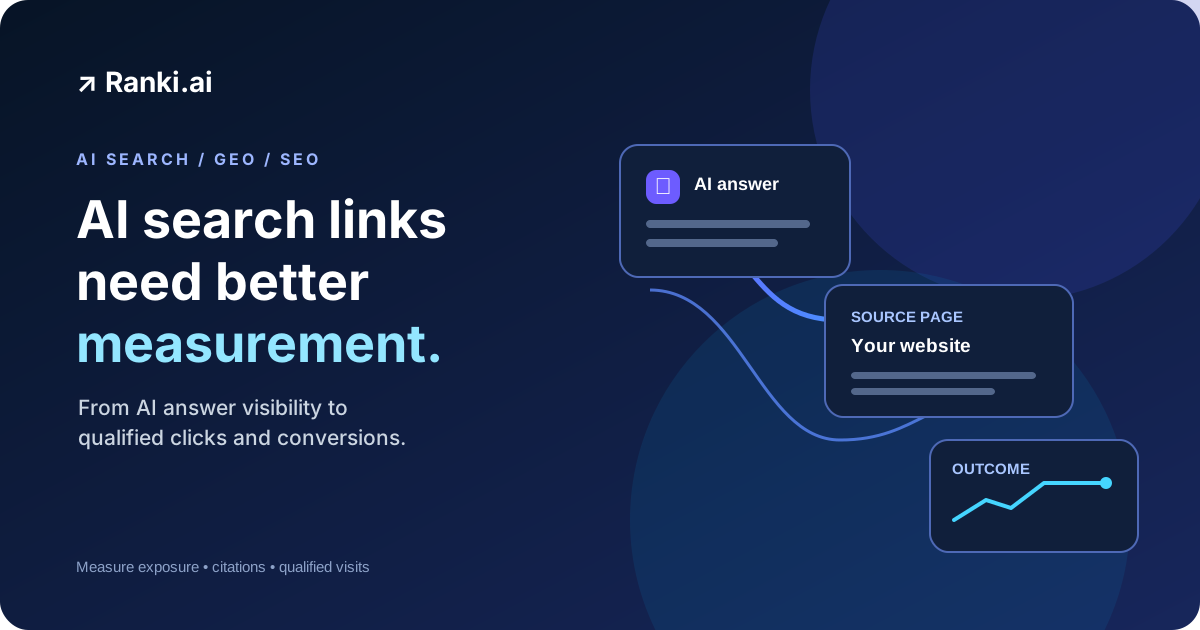
The shift: an AI answer is also a route to the web
AI search is often discussed as if the only outcome were a brand mention inside a generated answer. But the user journey can continue: someone reads a summary, checks a supporting source, compares a product page and eventually converts. The practical question for a publisher is not simply, “Did the model mention us?” It is, “Were we present when the question mattered, and did that presence help a person take the next step?”
On October 15, Google announced changes across AI Mode and AI Overviews intended to make links and source discovery more useful. The exact experience can vary by query, feature, device and rollout. Treat this as a reason to audit your own priority searches—not as evidence that every publisher will receive more clicks.
First, separate the three metrics people call AI visibility
A single score can hide the reason a page is not performing. Keep these layers separate in your reporting so the team can decide what to fix.
- Feature coverage: for a defined query set, how often does an AI feature appear at all? This is about the search result, not your brand.
- Answer presence: when the feature appears, is your brand named, is your page linked as a source, and is the cited page actually relevant to the claim?
- Business outcome: do those appearances lead to measurable referral sessions, engaged visits, sign-ups, product views or sales? A mention without a click may still matter, but do not count it as a visit.
What Google's official guidance means for your technical checklist
Google's Search Central documentation says pages must be indexed and eligible to appear with a snippet in regular Google Search to be eligible as supporting links in AI Overviews or AI Mode. It says there are no additional technical requirements just for those AI features. That is a useful corrective to advice promising a special AI schema, a magic file or a guaranteed shortcut.
Start with the basics on the pages that matter commercially: product and category pages, pricing, comparison pages, integration docs and original research. Confirm that each URL returns the intended content, can be crawled under your chosen access policy, has a sensible canonical, and is not accidentally excluded by a robots or noindex rule. Structured data should describe content users can see; it should not be used to invent claims or ratings.
Then make the source genuinely useful. Put key facts near the claim they support, explain methods and limitations, name the author or organization responsible, and link to primary evidence. For ecommerce, make specifications, price conditions, availability and compatibility easy to find. For SaaS, explain integrations, security boundaries, pricing limits and what the product does not do.
Build a repeatable AI-search measurement loop
A handful of screenshots is not a trend line. Build a small, stable test set around the questions real buyers ask, and record observations consistently. Include branded queries, non-branded problem queries, comparisons and purchase-intent questions. Keep wording and market consistent between checks; otherwise a changed prompt can look like a visibility gain or loss.
For each check, record the date, platform and mode, exact prompt, whether an AI feature appeared, brand mention, cited URL, competing sources and a screenshot or evidence note. Recheck a sample rather than attempting to track every possible question. AI answers are dynamic, so report the sample size and observation window instead of presenting a snapshot as universal truth.
Join that evidence to your existing analytics. Use Search Console for Google's search performance data and your analytics platform for landing pages, referral sources and conversions. Referral attribution may be incomplete: not every AI exposure produces a click, and analytics cannot reliably reveal every time a brand was seen in an answer. State those limitations in the report.
- Weekly: review a stable set of high-value questions and save source evidence.
- Monthly: compare citation and brand-presence rates by topic, page type and competitor.
- After a change: annotate the date you updated content, technical access or internal links, then compare the same query set over a reasonable period.
- Always: distinguish correlation from causation. A traffic increase after a content update does not prove the update caused an AI citation.
What to do when a competitor is cited instead
Open the cited page and ask why it is the better source for that particular question. Does it answer the question more directly? Does it include original data, clear definitions, an up-to-date comparison or first-hand evidence that your page lacks? Is your key information hidden in a client-side interaction, image or PDF? Fix the evidence gap before simply repeating the target keyword more often.
Look for a relevant page on your own site that could serve the same user need, then improve it without copying the competitor. Add a concise answer, transparent supporting detail, appropriate internal links and clear ownership. If no page genuinely answers the question, create one only when it helps your audience—not to inflate a publishing calendar.
This is where a workflow matters more than a one-off optimization. Ranki.ai can support a consistent research and content process, but no tool can guarantee that Google or another answer engine will cite a particular page. Treat content production as one part of a system that also includes technical accessibility, evidence quality and measurement.
A 30-minute action plan for this week
Choose five questions that influence a real purchase decision. Check them in the relevant AI search experiences and capture the source links. For each question, identify the best matching page on your site, verify its indexing eligibility and inspect whether the content supports the claims you want users to understand. Then choose one measurable improvement: clearer pricing, better documentation, a missing comparison, stronger internal linking or a more useful evidence section.
Record the baseline before editing. Revisit the same questions after the change and compare what actually changed: answer presence, source selection, clicks or conversions. If the evidence is mixed, say so. Good AI-search reporting is not about producing a flattering score; it is about making the next decision less speculative.
Frequently asked questions
Does Google guarantee more traffic from the AI search link changes?
No. The announcement describes product changes, not a traffic guarantee for individual websites. Measure your own query set and analytics data.
Do I need special schema markup for AI Overviews or AI Mode?
Google's current Search Central guidance says there are no additional technical requirements for these AI features. Use valid structured data when it accurately represents visible page content, and follow normal Search eligibility guidance.
Can AI visibility be measured in Google Analytics alone?
No. Analytics can measure some visits and outcomes, but it cannot show every impression or mention inside an AI answer. Combine it with Search Console and a documented, repeatable sample of AI-search observations.
Sources and further reading
Independent primary references selected for their relevance. These are not sponsored placements.
- Google Search Central — AI features and your website ↗
Google's official technical eligibility guidance for supporting links in AI Overviews and AI Mode.
- Google Search — AI Mode and AI Overviews ↗
Google's product context for AI-powered Search experiences and links to further information.
- Google Search Console Help — Performance report ↗
Reference for understanding Search Console performance data and its reporting boundaries.
- Google Search Central — Introduction to structured data ↗
Official guidance on using structured data to describe page content accurately.

Ready to make your brand easier to find?
Connect Google SEO, AI search discoverability, local presence and content into a focused marketing strategy. Share your brand and goals with our team.
Joining the waitlist is free. Rankings and AI citations are never guaranteed.