

1. Audit entity clarity and technical access
Check whether the site consistently states the brand name, company identity, product category, audience and core capabilities. A strong site has a canonical product page, an about page, feature and integration references and consistent structured data using stable identifiers.
Important marketing and source pages should also be publicly crawlable, return stable status codes and use canonical URLs. Private dashboards, onboarding steps and internal APIs should stay out of search.
2. Audit buyer-question and decision coverage
Map the unbranded questions buyers ask before selecting a tool or supplier. Then check whether the site has a clear page for each durable intent: definitions, category guides, comparisons, use cases, integrations, pricing logic, alternatives, methodology and proof.
Flag missing intents and duplicate pages separately. Publishing a new page is not always the answer; sometimes one strong existing page should be expanded and internally linked.
3. Audit first-party evidence
Review whether key claims are supported by product documentation, original measurements, methodology, screenshots, public profiles or attributed external sources. Concrete facts give retrieval systems and buyers something they can verify.
Do not create fake customer stories, fabricated awards or invented benchmarks for the sake of GEO. Unverifiable proof can damage credibility and gives assistants weak evidence to work with.
4. Measure visibility and create the action plan
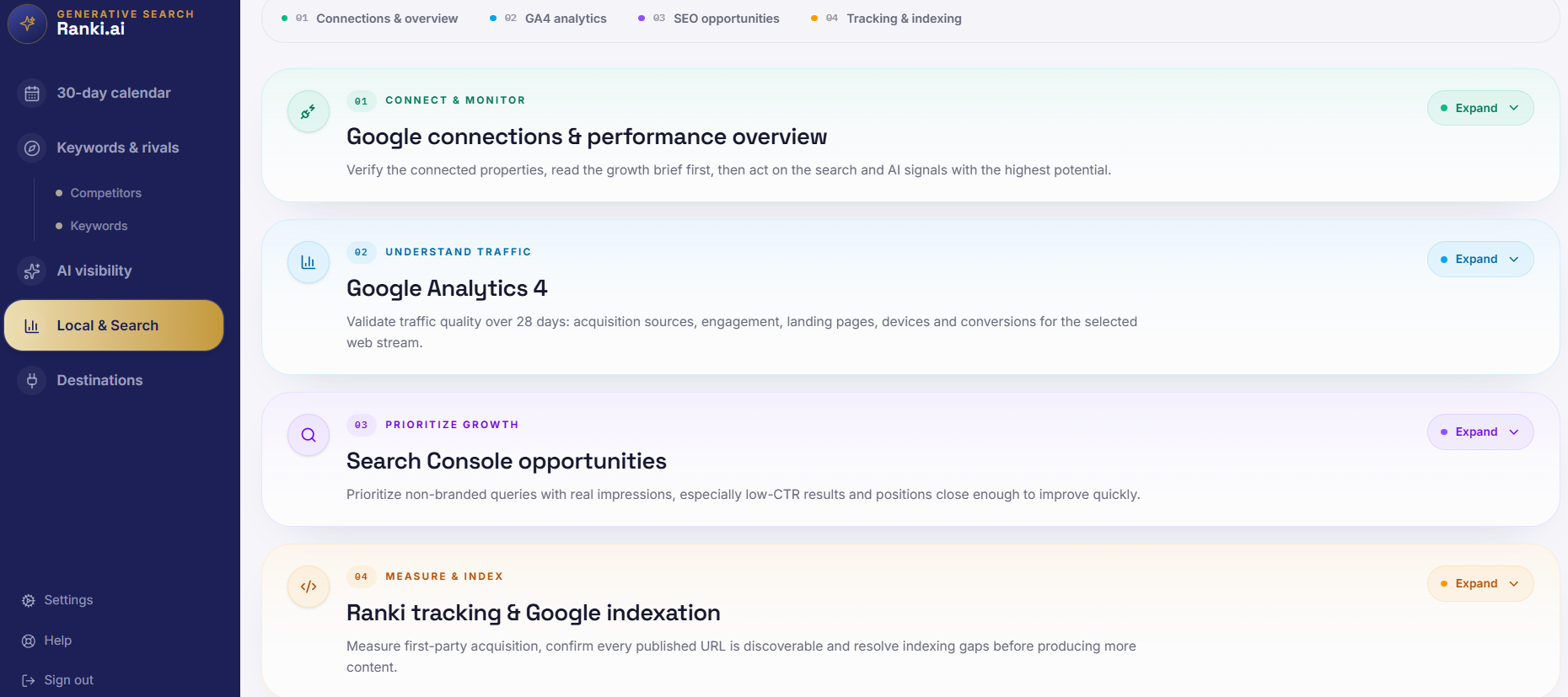
Run a stable set of unbranded buyer questions and record mentions, recommendations, citations, source URLs and competitor presence. The result is a baseline, not a permanent ranking.
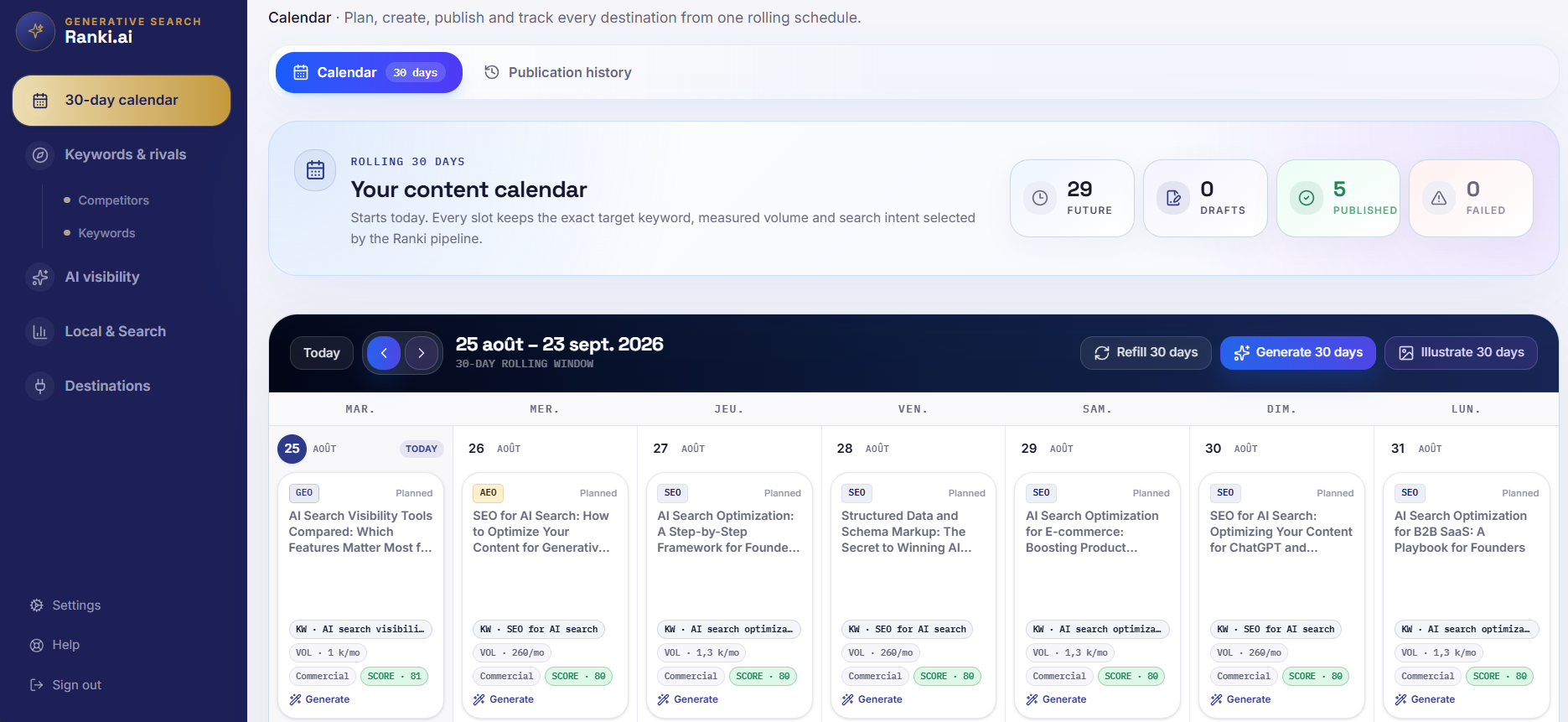
Ranki.ai can turn the highest-value gaps into a rolling calendar so the audit ends with execution: which page to create, which fact to clarify, which source to strengthen and which question to re-test.
Frequently asked questions
Is a GEO audit the same as a technical SEO audit?
No. Technical SEO is one layer. A GEO audit also checks entity clarity, source evidence, buyer-question coverage and observed presence in generative answers.
Can a GEO audit guarantee more AI citations?
No. It can identify missing or weak public signals and provide a measurable improvement plan, but independent AI providers decide what to retrieve and cite.
How often should a GEO audit be repeated?
A deep audit can be periodic, while stable visibility questions and key technical checks can be repeated more frequently to detect meaningful changes.
Ranki.ai · GEO + SEO + AEO on autopilot
Turn the strategy into a 30-day execution plan
Ranki.ai connects research, editorial planning, content generation, publishing and visibility measurement in one workflow.
Analyze my site free