

1. Check intent ownership and the direct answer
Every important page should have a primary question or decision it clearly owns. If one URL tries to answer several unrelated intents, the direct answer becomes ambiguous. If many URLs target the same intent, the site can fragment its authority.
The main answer should appear early enough that a reader or retrieval system does not need to reconstruct the conclusion from several introductory paragraphs. If the correct response depends on conditions, state those conditions instead of forcing an overconfident one-line claim.
2. Check supporting structure
Descriptive H2 and H3 sections should correspond to real subquestions. Lists and tables are useful when they improve comprehension, not as decoration. FAQs should add missing information instead of repeating the same sentence with different wording.
Internal links should connect the answer page to the relevant product, methodology and deeper supporting resources so the page sits inside a coherent information architecture.
3. Check evidence and entity facts
A direct answer is stronger when important claims can be verified. Add first-party product facts, methodology, dates, data sources and limitations where they matter. Keep the product name, company name and category consistent across the site.
For software pages, a factual feature reference, integration page and public third-party profile can help buyers and retrieval systems confirm that the product exists and understand what it does.
4. Measure the answer after publishing
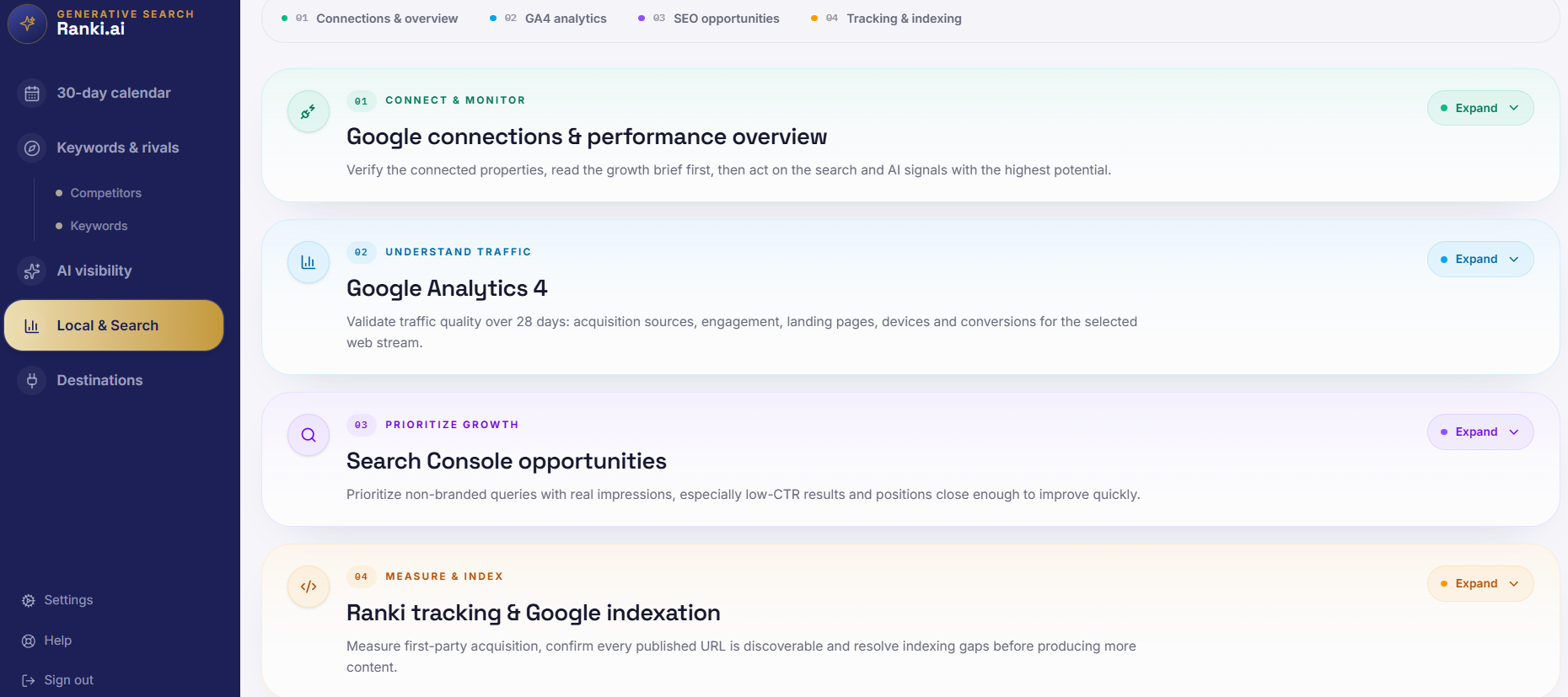
AEO is not complete when the page is written. Track whether the page gains search impressions for the target question, whether users engage with it and whether supported AI-answer tests include or cite the content over time.
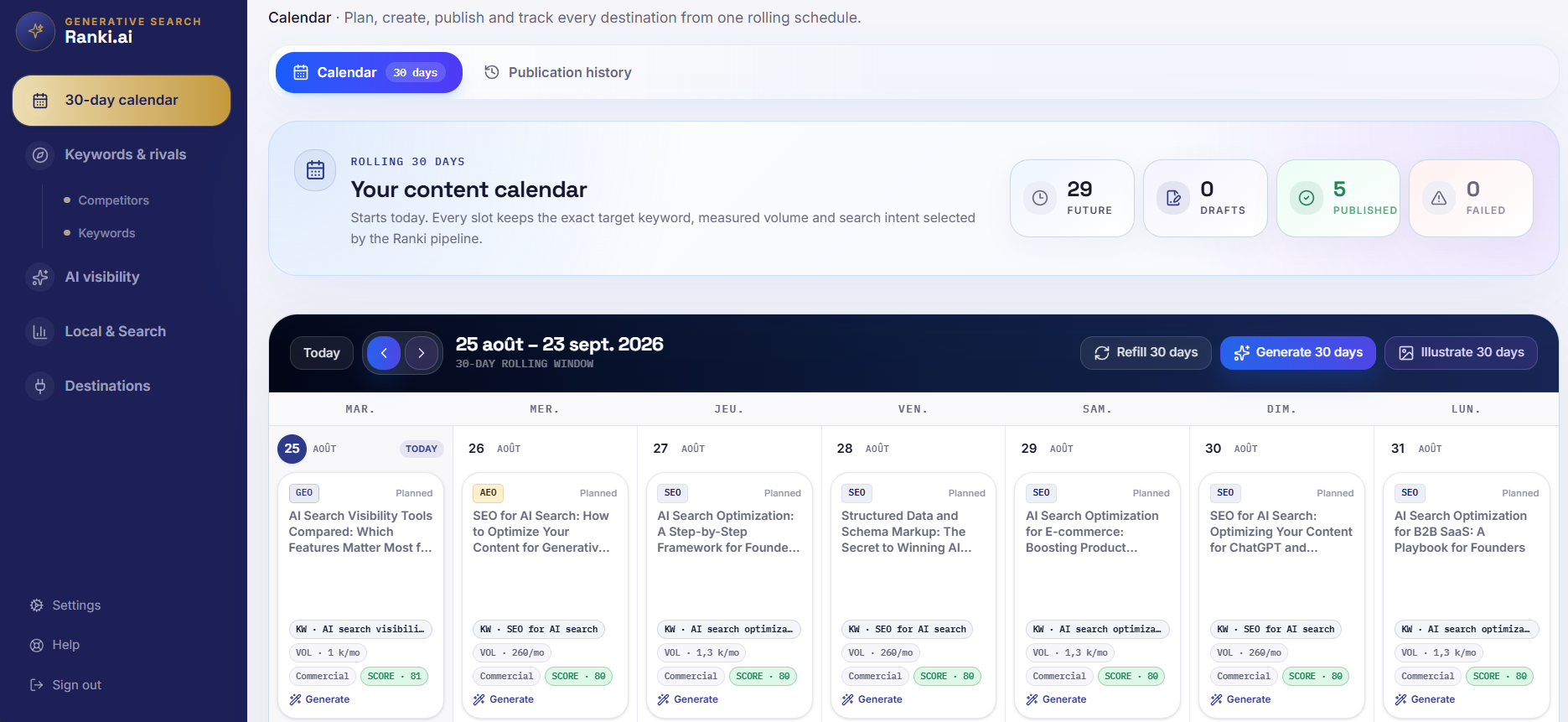
Ranki.ai can place the highest-priority answer gaps into the 30-day plan, publish improved pages and re-run the same question set so the audit becomes a measurable cycle rather than a static checklist.
Frequently asked questions
What is the difference between an AEO audit and a GEO audit?
AEO focuses on the quality and structure of direct answers to specific questions. GEO is broader and also examines entity clarity, retrievability, source authority, decision coverage and citation visibility.
Do FAQ schema and FAQ sections guarantee AI visibility?
No. Useful FAQ content can improve clarity, but schema alone does not guarantee ranking or citation. The underlying answer still needs to be useful, accessible and trustworthy.
Should every page have a direct-answer box?
No. It is most useful when the page resolves a clear question or decision. Purely navigational or transactional pages may not need one.
Ranki.ai · GEO + SEO + AEO on autopilot
Turn the strategy into a 30-day execution plan
Ranki.ai connects research, editorial planning, content generation, publishing and visibility measurement in one workflow.
Analyze my site free